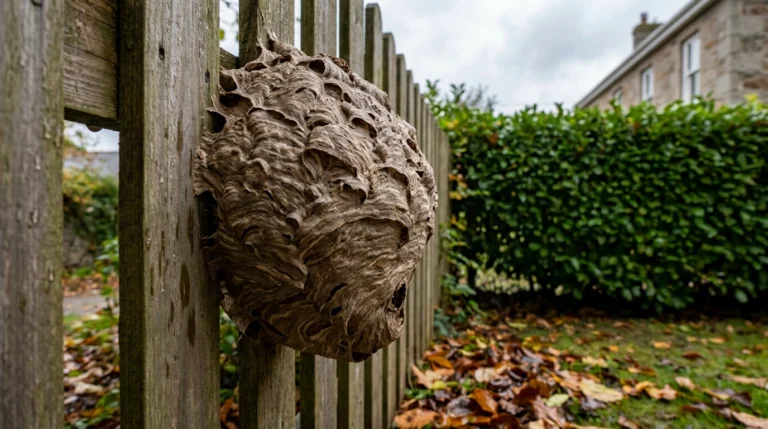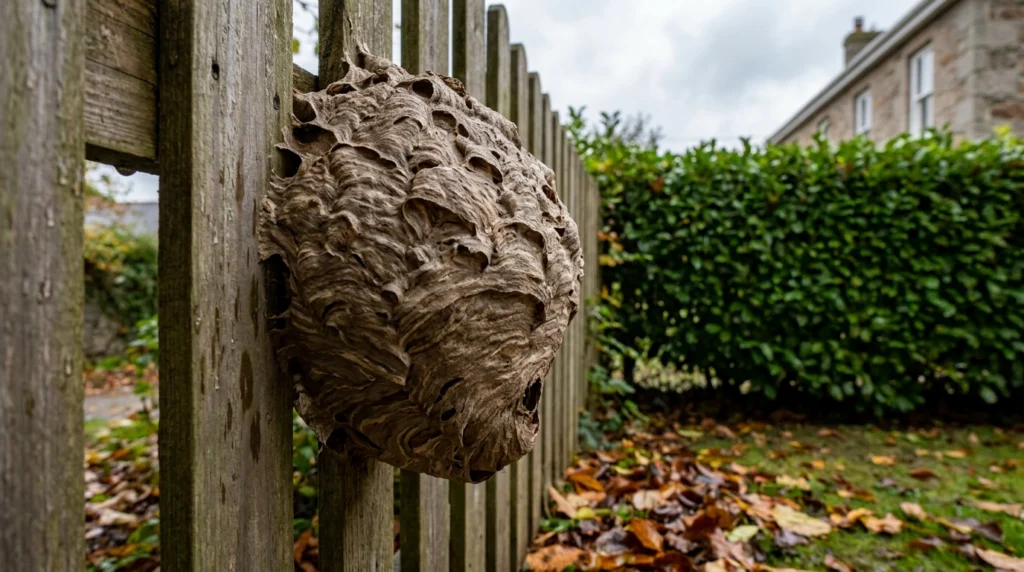
In brief: Fifty Asian hornet sting incidents were recorded in Jersey last year, including one anaphylactic reaction and several hospital attendances. Nest numbers are up 50% on last year, with around 1,000 expected across the island in 2026. The Environment Minister has warned that serious sting incidents are likely to increase.
A Growing Sting in the Tail
If you thought the biggest hazard in a Jersey garden was an overly competitive neighbour at the barbecue, think again. The Jersey Evening Post reports that 50 Asian hornet sting incidents were recorded on the island last year, including one confirmed anaphylactic reaction and a number of hospital attendances. Most incidents followed the accidental disturbance of nests, and officers are also aware of near misses involving islanders, contractors and children who narrowly avoided what could have been serious injuries.
Environment Minister Mary Le Hegarat has been candid about the trajectory. “The likelihood of serious sting incidents, including life-threatening reactions, is expected to increase,” she said, responding to questions from Deputy Louise Doublet in the States Assembly. It is the kind of statement that tends to focus the mind, particularly for parents, outdoor workers and anyone who spends time in Jersey’s parks and countryside.
Nest Numbers Climbing Sharply
The scale of the problem is becoming harder to ignore. More than 800 nests had been identified by early October this year, which is 50% more than at the same point in 2025. The vast majority have been successfully destroyed, but the numbers keep climbing. Around 1,000 nests are forecast for 2026 as a whole, and Jersey is thought to be capable of supporting as many as 2,000.
The hornets’ expanding presence has already caused real disruption to daily life, with temporary restrictions put in place at schools, parks, visitor attractions and hospitality venues. For an island whose economy depends heavily on tourism and outdoor hospitality, that is not a trivial inconvenience.
Senator Le Hegarat acknowledged that the insects are increasingly becoming, in her words, “a broader public safety and public service challenge.” That is a measured way of saying that what began as an environmental concern has now crossed firmly into the territory of public health and economic risk.
Costs Rising, Eradication Off the Table
The financial cost of the island’s control programme is expected to reach approximately £90,000 this year, up from £74,000 in 2025 and £71,000 in 2024. Those figures, the Jersey Evening Post notes, exclude the thousands of hours donated by volunteers from the Jersey Asian Hornet Group, whose contribution to the effort is considerable and largely invisible in the official budget line.
Complete eradication has never been considered achievable, according to the Minister, given the established population in Jersey, the large populations in neighbouring France, and the continuing risk of natural reintroduction across the water. The programme instead focuses on slowing the species’ establishment, destroying nests where found, and reducing harm to wildlife, businesses and public safety. It is a management strategy rather than a cure, which means this is a long-term commitment of public funds with no obvious end point.
Senator Le Hegarat indicated that long-term management is likely to require additional resources and a more coordinated response across government, public services, businesses and volunteers. Exactly what that means in practice, and what it will cost, remains to be seen.
Source: Jersey Evening Post