In brief: The Government of Jersey spent more than £26,500 of public money making two St Helier properties safe after their walls were judged at risk of collapse. The bills are expected to be sent to the property owners, but whether they will be paid, and whether any prosecution will follow, remains unresolved.
Walls, warnings and a £26,500 bill
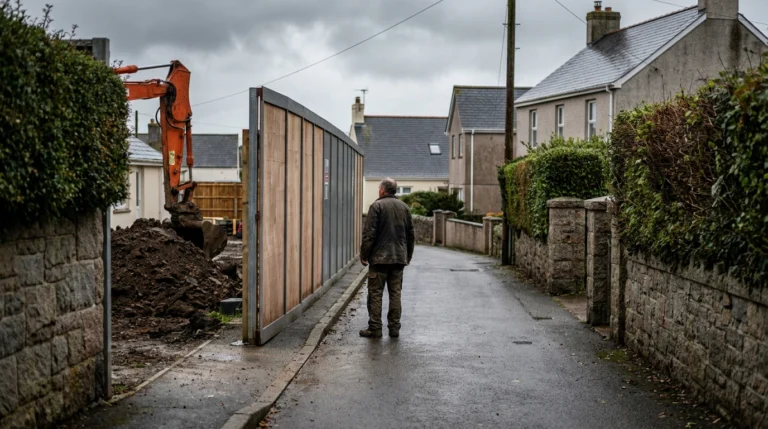
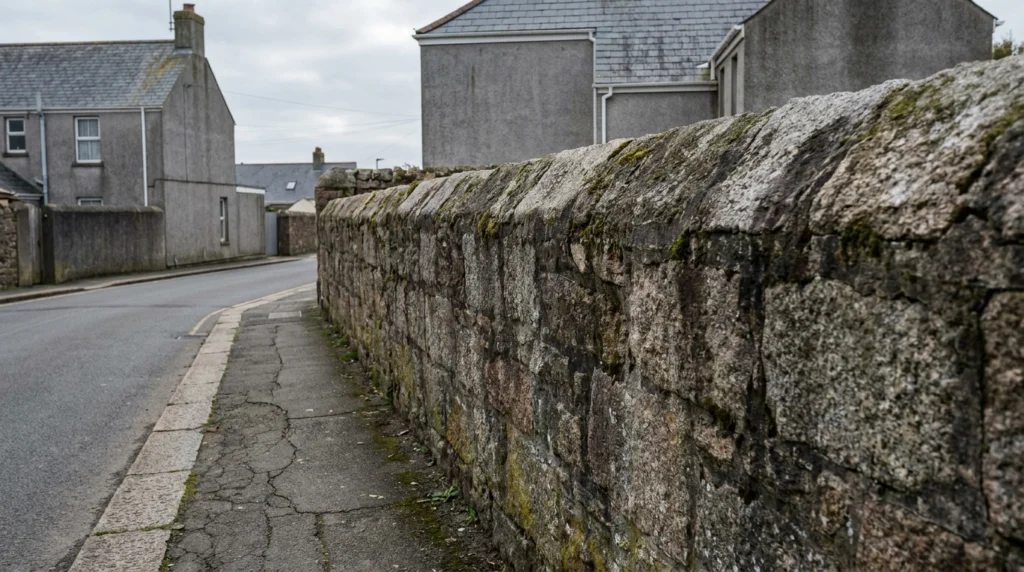
A Dangerous Building Notice was issued on 29 May 2026 for two properties at Rouge Bouillon, Ashton Villa and Channel Mews, after inspectors determined that their walls were in a dangerous and unstable condition, posing a risk of collapse onto the adjoining public footpath and road. Temporary traffic lights, a single lane closure and a partial footpath closure were put in place while the situation was dealt with.
The Government of Jersey has confirmed, in response to a written States question from Deputy Hillary, that £23,390.67 was spent on the works required to remove the danger, with a further £3,133.50 incurred for road closures and traffic management, bringing the total public expenditure to just over £26,500.
Planning Minister Senator Sir Mark Boleat was at pains to clarify the scope of the intervention. “The works specified in a dangerous building notice are limited to those works required to make the building safe,” he said, “and the direct action taken did not include further repairs of a permanent or temporary nature. The site was handed over in a safe condition to the landowners, and any further repairs or works are the responsibility of the owners.”
Who pays, and when?
The Government says it intends to recover the costs under Article 69 of the Planning and Building (Jersey) Law 2002. Senator Boleat confirmed that the government is currently determining how much of the total should be allocated to each property owner, with invoices expected to be issued shortly.
Should the bills go unpaid, the outstanding sums could be pursued through debt-recovery procedures involving the Law Officers’ Department. That is a process that carries its own administrative costs, of course, and there is no guarantee of a swift resolution.
Could there be a prosecution?
Deputy Jeune also asked whether enforcement action had been taken over the Dangerous Building Notice. Senator Boleat’s response was that carrying out the works in default already constituted enforcement action in itself. However, he noted that failure to comply with a Dangerous Building Notice is also an offence under Article 70 of the Planning and Building (Jersey) Law 2002.
The Regulation Directorate is currently considering its position on the matter, taking guidance from the Law Officers’ Department on regulatory breaches. Senator Boleat noted that the Attorney General is ultimately responsible for deciding whether any prosecution should be brought. In other words, the legal picture remains open.
Source: Bailiwick Express