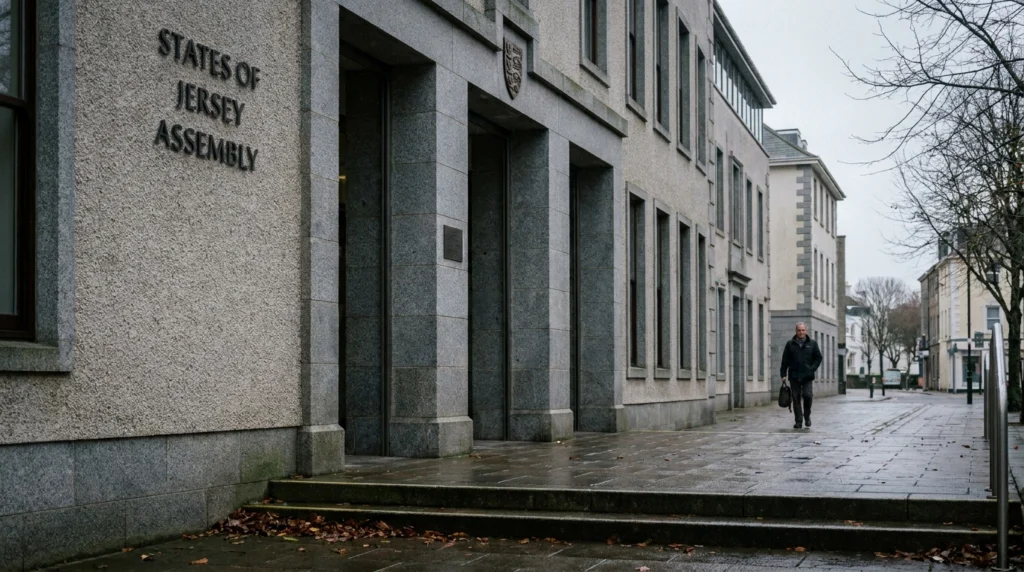
In brief: Jersey’s Privileges and Procedures Committee is reviewing how it handles conduct complaints against former politicians, after two upheld complaints against former Deputy Philip Ozouf were confirmed but their details withheld from the public. The committee published only a brief summary, citing legal and data protection considerations, and no further action will follow.
What Happened With the Ozouf Complaints
The Privileges and Procedures Committee confirmed last month that former Deputy Philip Ozouf had breached the Members’ Code of Conduct, following an investigation by the Commissioner for Standards into two complaints, both of which were upheld. The committee agreed that breaches had occurred.
However, Islanders were left none the wiser as to what, precisely, he did wrong. Rather than publishing the Commissioner’s full report, as it normally does when a breach is found, the committee released only a brief summary that gave no details of either complaint. The case was then closed on the basis that Mr Ozouf is no longer a States Member, and no further action will follow.
Bailiwick Express reports that the committee received the findings in July, after the investigations were completed in the run-up to the election. In its published summary, the committee described dealing with reports about former Members as “highly unusual”, adding: “Whatever the outcome, the public must be assured that Members remain accountable for their actions whilst they are representing Islanders. That is how we build trust.” Whether publishing a summary with no details of the actual breaches quite achieves that goal is, one might argue, a matter of perspective.
Questions in the Assembly
Deputy Jonathan Renouf pressed committee chair Deputy Carina Alves on the matter, asking what advice the committee had received before withholding the full report, and whether the case had exposed a need to change how complaints involving former Members are handled.
Deputy Alves explained that the committee had considered legal and data protection advice, as well as representations made on Mr Ozouf’s behalf. She said the committee had weighed the need for transparency and accountability for Members’ conduct in office against privacy and data protection requirements, before deciding to publish only a summary.
Deputy Alves also placed on record her own preference for full publication in cases where a breach is found, a notable detail given that the committee ultimately chose the more restricted approach.
Deputy Renouf also asked a pointed hypothetical: would a report about a former Member be published if that person were subsequently re-elected? Deputy Alves declined to be drawn, saying: “Any such case would be considered on its own facts and in accordance with the procedures and regulatory framework in force at the time. It would not be appropriate to prejudge a future decision.” A careful answer, and a perfectly reasonable one, though it does leave the question hanging in the air.
Procedures Under Review
The committee has acknowledged that the Ozouf case has exposed a gap in its procedures. Deputy Alves confirmed: “The Committee has reflected on the issues raised by this case and is considering developing procedures in relation to investigations involving former States Members.”
At present, the framework appears to have been designed primarily with sitting Members in mind. When a Member leaves office before an investigation concludes, or before findings are published, the committee finds itself in uncertain territory, balancing public accountability against data protection obligations and the absence of any ongoing disciplinary lever to pull.
The tension here is a genuine one. On one hand, the public has a legitimate interest in knowing how their elected representatives conducted themselves while in office. On the other, data protection law does not simply evaporate because a matter is politically inconvenient, and the committee is right to take legal advice seriously.
Source: Bailiwick Express