In brief: Industry experts are warning businesses in Jersey and beyond that redundant technology, from old laptops to retired servers, may represent a greater data risk than the shiny new systems they have replaced. Meanwhile, a separate voice in the field argues that the digital footprints people leave online are equally worth scrutinising, with AI now able to surface decision-influencing information about prospective clients and staff within hours.
The cupboard that could cost you
Stuart Moseley of ITHSCI, writing in the Jersey Evening Post, makes a point that is both obvious and almost universally ignored: when businesses upgrade their technology, they spend considerable time and money on the new equipment and almost no time at all on the old. The result, he argues, is that the biggest data risk in many organisations is not lurking behind a sophisticated cyber-attack. It is sitting in a storeroom, switched off, gathering dust.
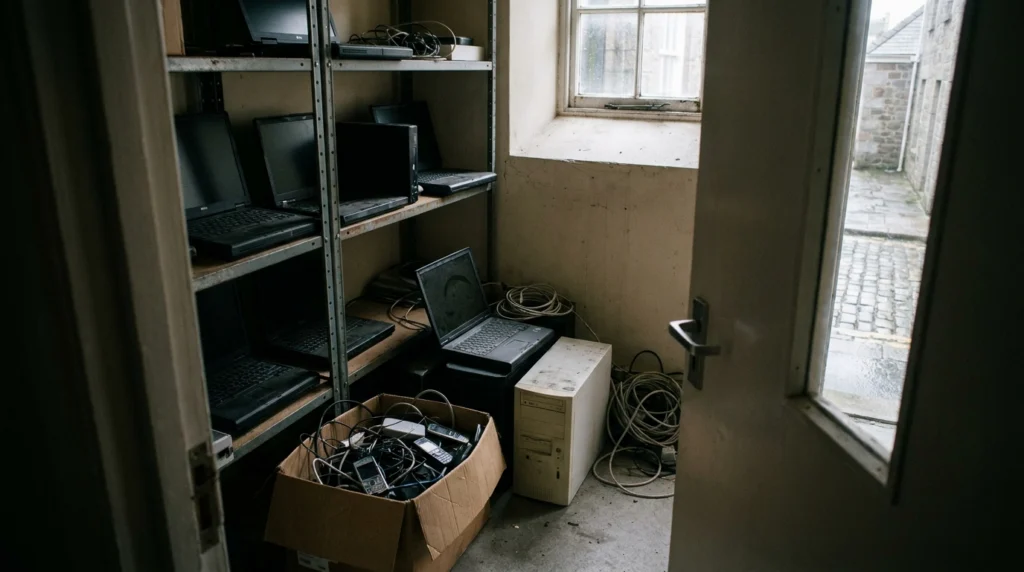
Old laptops, retired servers, redundant mobile phones and forgotten hard drives can all retain customer records, employee information, emails, financial documents, passwords and commercially sensitive material. Moseley is clear that disconnecting a device from the network does not make it safe. Deleting files or performing a factory reset, he warns, may not be sufficient to make that information irretrievable.
The pattern is familiar to anyone who has worked in a mid-sized organisation. A new laptop arrives, the old one goes into a drawer “for now”. A member of staff leaves and their phone is placed in a box with six others. A server is replaced and wheeled into a back room where it joins equipment from three previous upgrades. Months become years, and nobody is quite sure what is in there, who it belonged to, or what it contains.
A lifecycle, not a launch
Moseley’s argument is that digital transformation should be treated as a complete lifecycle rather than simply the purchase and installation of new technology. A project, he says, is not finished when the new system goes live. It finishes when the equipment being replaced has been identified, assessed and dealt with securely.
That does not necessarily mean destruction. Equipment that still functions can be securely erased, tested and given a second life, reducing waste and supporting the circular economy while allowing a business to recover some value from assets it no longer needs. Where data cannot be erased securely, or where a storage device is damaged, physical destruction may be appropriate. The key point, Moseley stresses, is that the decision should be deliberate, documented and proportionate to the sensitivity of the information involved.
The Jersey Office of the Information Commissioner has reinforced this position through its lessons from enforcement activity, noting that organisations should have clear answers about both when personal information will be disposed of and how it will be disposed of securely. Critically, the Commissioner stressed that having a policy is not enough: organisations must be able to demonstrate that the process is actually being followed. A sentence buried in a data-protection document is worth precisely nothing if nobody knows who is responsible for the old equipment or where it has gone.
Moseley sets out a practical checklist for any organisation willing to take the issue seriously: maintain an inventory of retired assets, record serial numbers, document whether data was erased or destroyed, and if an external provider is used, ensure there is a clear audit trail. The first step, he suggests, does not need to be complicated. Open the cupboard and find out what is in it.
What your digital footprint says about you
The Jersey Evening Post also reports on a rather different angle on data risk: not what businesses leave behind on old hardware, but what individuals leave behind on the internet. Richard Tavernor, founder and chief executive of Yoono, has built an AI-based investigative platform designed to find decision-influencing information about prospective clients and staff. According to the JEP, the platform can surface relevant information within a couple of hours.
Tavernor’s observation is straightforward: “We often leave a footprint behind, don’t we? And it’s very hard not to.” For businesses conducting due diligence on new hires or potential partners, that footprint, assembled and analysed at speed by artificial intelligence, represents both an opportunity and a warning. The same tools that help a compliance team assess a prospective client can, in the wrong hands or with inadequate oversight, raise serious questions about privacy and proportionality.
Source: Jersey Evening Post