In brief: Plans have been submitted to restore the Grade 2-listed Napoleonic guardhouse at Archirondel, St Martin, and convert it into a holiday let. A separate cedar-clad four-bed bunkhouse would be built behind it, with the scheme targeted specifically at cycling and walking tourists.
A Relic of the Napoleonic Wars Gets a Second Life
A crumbling piece of Jersey’s coastal defence history could be brought back from the brink, if new planning proposals get the green light. Bailiwick Express reports that plans have been submitted to renovate the Grade 2-listed Archirondel Guardhouse on La Rue des Viviers in St Martin and transform it into a holiday let, complete with a new bunkhouse tucked in behind it.
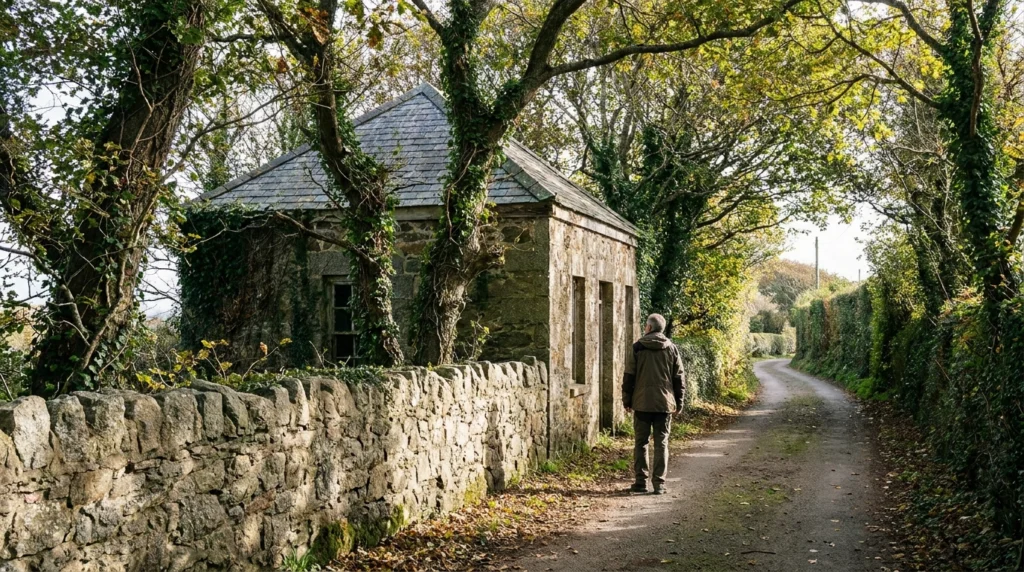
Built around 1810, the guardhouse served a nearby gun battery overlooking St Catherine’s Bay. It formed part of what its listing describes as a “continuous chain of defensive structures around the coast”, where the local militia kept watch for potential French landings. Jersey was, of course, no stranger to that particular threat, and the men who stood guard here were in deadly earnest. More than two centuries later, the most dangerous thing likely to breach the perimeter is a soggy cyclist looking for somewhere to dry their socks.
The battery itself was eventually lost when transport routes were constructed to carry granite to the breakwaters at St Catherine’s and Archirondel. The guardhouse, however, survived, though not without considerable suffering. Its gunpowder store still retains its vaulted brick ceiling, but the adjoining guardroom has lost its roof entirely and sustained what the plans describe as “major structural damage”. Landslips have piled debris against the walls, and trees and vegetation are growing through the structure itself.
The Plans: Sensitive Restoration with a Practical Twist
The architects behind the project, Dyson and Buesnel, have concluded that the guardhouse itself is simply too small to accommodate four bunks. Their solution is a separate cedar-clad bunkhouse with a smaller footprint than the guardhouse, positioned directly behind it to minimise its visibility from the road and reduce the need for outdoor lighting.
The restored guardhouse would contain kitchen and bathroom facilities, and a small clearing beyond the tree line would be levelled to allow guests to pitch a tent during the holiday season. The holiday let would have no guest parking, with the planning statement making clear it is “targeted at cycling or walking tourists”.
The restoration approach is admirably pragmatic. Stone and brick recovered from the landslip debris would be reused in the repairs, and collapsed sections of the roadside granite wall would be rebuilt. The footpath from the road would be reinstated, bicycle storage added, and three oak trees planted to replace three sycamores that the architects say are actively damaging the guardhouse. Removing trees to save a historic building: a refreshingly sensible set of priorities.
On the financial side, Dyson and Buesnel estimate that income from groups of four, based on 70% occupancy during the holiday season, would make the restoration financially viable. Given the alternative, which is watching a listed Napoleonic structure slowly disappear under a tangle of roots and rubble, the economics seem rather compelling.
Heritage, Tourism and the Coastal Path
Jersey’s network of coastal paths and its cycling infrastructure make this kind of low-impact, active-tourism accommodation a natural fit. The Archirondel area is already well used by walkers and cyclists, and a thoughtfully restored historic building offering bunkhouse-style accommodation would add genuine character to what is already a beautiful stretch of the island’s east coast.
The proposal also raises a broader point about how Jersey manages its built heritage. Listed structures left to decay are not preserved: they are simply lost more slowly. A scheme that funds restoration through sustainable tourism use, reuses materials from the site itself, and avoids car-dependent visitor traffic is about as sensible an approach as one could hope for.
Source: Bailiwick Express