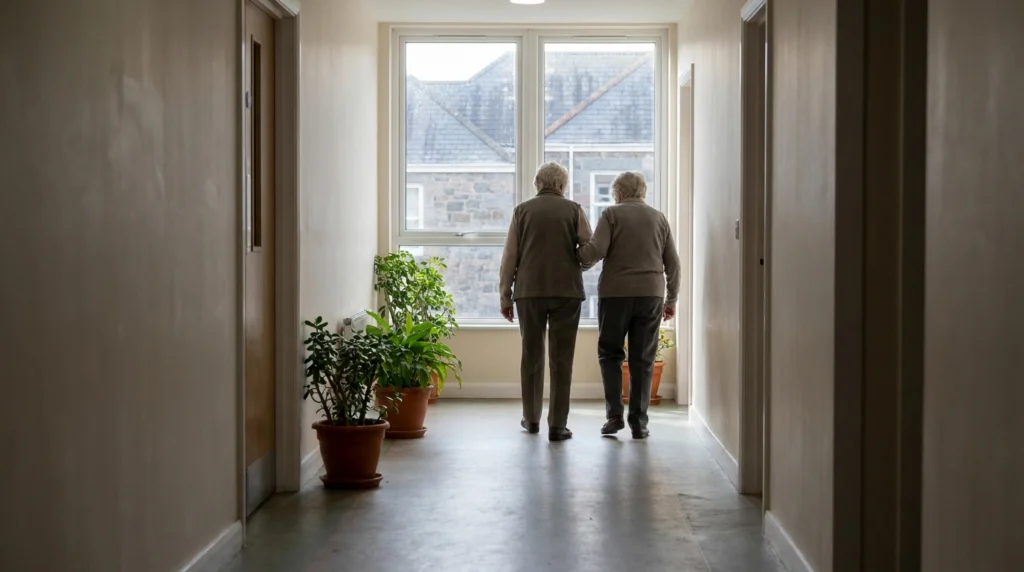
In brief: Jersey’s health chief has warned that extra money alone may not persuade nursing homes to take patients with severe dementia, because providers fear serious incidents could put their registration at risk. Around a dozen patients are routinely stuck in hospital waiting for suitable nursing beds, at an estimated cost of roughly £600 a night each.
A shortage money cannot simply fix
Jersey’s health chief officer, Tom Walker, has told the Public Accounts Committee that the island faces a stubborn shortage of nursing home beds for people with the most severe dementia, and that throwing more cash at the problem may not be enough to solve it. The Jersey Evening Post reports that Mr Walker made the remarks this week, following the paper’s own reporting in September that dementia patients were deteriorating while waiting around three months in hospital for nursing home places.
At the heart of the problem, Mr Walker explained, is not money but risk. Commercial care homes, he told the committee, are regulated providers who weigh up the consequences of accepting the most challenging patients. As he put it: “I could fill that bed with a less risky patient for the same financial return and then I would not risk having a really serious incident that then endangers my registration with the Jersey Care Commission.”
In other words, a care home operator has every rational incentive to take a more manageable resident at the same rate rather than accept someone whose complex needs raise the likelihood of a serious incident and, with it, the threat of losing their licence to operate. Higher payments through the long-term care scheme, Mr Walker suggested, would not change that calculation.
Patients stuck, costs mounting
The practical consequence is that around a dozen patients are, at any given time, occupying hospital beds for far longer than intended while waiting for one of a very small number of intensive nursing places to become available. Mr Walker estimated the cost of a hospital bed at roughly £600 a night, a figure that puts the daily bill for those delayed transfers alone into the thousands of pounds.
This is not a new concern. The JEP reported in September that Health managing director Andy Weir had warned that without more capacity, the new hospital risked becoming, in his words, “the most expensive nursing home in the world.” Mr Walker acknowledged this week that measures to improve the flow of patients through the hospital had produced results, but said they could not resolve the underlying shortage of beds.
His assessment of the broader care market was nuanced: “The care market in Jersey works very well funded by the long-term care scheme, but it does not work so well for people with the highest acuity.” People with very serious dementia, he said, are “particularly challenging for commercial care homes to accommodate.”
Investment needed, but from whom?
Mr Walker was direct about what is ultimately required. “It needs an investment by somebody, either the private sector or the public sector, in nursing bed capacity for people with the most severe dementia and other serious conditions,” he told the committee.
That framing leaves the question of who picks up the bill deliberately open. The private sector has shown little appetite for taking on the highest-risk residents at current rates. If the financial incentive is insufficient and the regulatory risk remains, the burden of providing that capacity may well fall on the public purse, whether through direct investment in facilities, a redesigned funding model, or some combination of the two.
For families of those affected, the situation is distressing in a way that no committee hearing fully captures. A loved one with severe dementia, deteriorating in a hospital ward while waiting months for an appropriate place, is not an abstract policy problem. It is a daily reality for a significant number of Jersey families right now.
Source: Jersey Evening Post