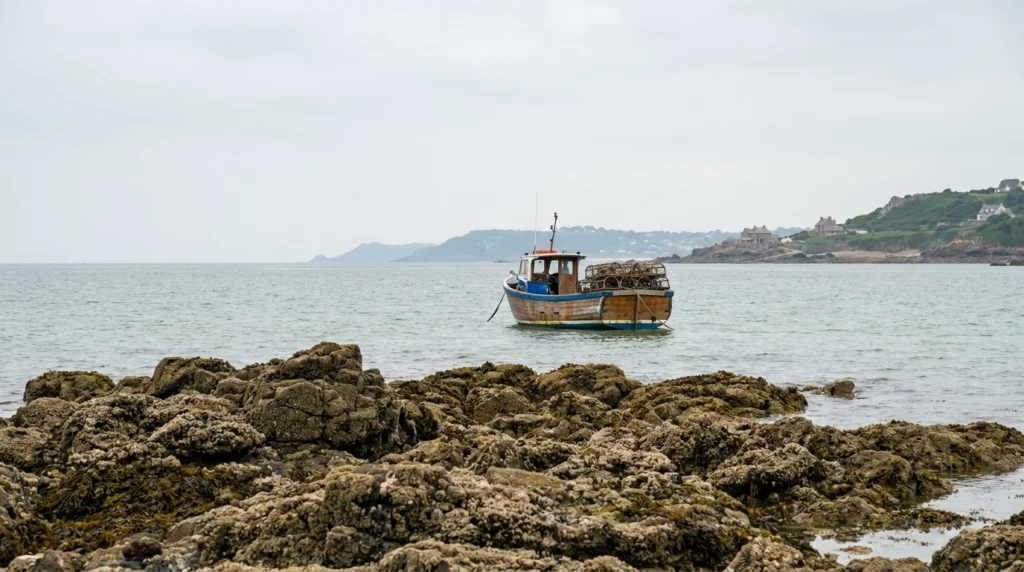
In brief: The States Assembly has voted unanimously to nearly treble the size of the lobster fishing ban zone at Les Écréhous, expanding it from 13.5km² to 40km². The move, backed by Jersey, Norman and Breton fishers alike, aims to reverse a dramatic collapse in lobster landings over the past decade.
A Fishery in Trouble
The numbers tell a stark story. According to the Jersey Evening Post, the weight of lobster landed by Jersey commercial fishing boats has plummeted from 250,000kg in 2015 to just 50,000kg last year. That is an 80 per cent decline in a single decade, and it is the kind of trajectory that tends to concentrate minds rather quickly.
Environment Minister Mary Le Hegarat lodged the proposition to expand the prohibited zone for parlour-pot fishing at Les Écréhous, arguing that the two-chambered pots cause “significant” levels of “unnecessary mortality” for lobsters in what she described as one of Jersey’s most productive habitats. The logic is straightforward: if you want more lobsters, stop killing so many of them in the places where they thrive.
Senator Le Hegarat noted that commercial potting for lobster remains a fishery of “critical importance” to the island. In 2025 alone, 46 tonnes of lobster were landed with a first-point-of-sale value of nearly £900,000. That is not a trivial sum, and it underlines why getting the management of this resource right matters not just ecologically but economically.
The Road to Les Écréhous
Jersey is not entirely new to this approach. A similar prohibited zone for parlour pots was established at Les Minquiers back in 2007 and is, as the Environment Minister put it, “generally agreed” to have been of benefit. The question was always why Les Écréhous had not received the same treatment.
The answer, it turns out, was diplomatic rather than scientific. The Bay of Granville Fishing Agreement, which governs shared waters between Jersey, Brittany and Normandy, had previously required any management decisions to be negotiated trilaterally. That process, as anyone familiar with cross-Channel fishing politics will appreciate, is rarely swift.
This time, however, the politics aligned with the science. Senator Le Hegarat told the Assembly that the measure had received the support of Norman and Breton fishers as well as Jersey’s own fleet, allowing the island to act without the compromises that have historically slowed progress. “Today, we have the advantage that with sound data and rational argument, logical measures can be implemented without compromise,” she said.
Unanimous Support, With a Note of Caution
The proposition passed by 40 votes to nil, a result that reflects genuine cross-party consensus on an issue where the evidence is hard to argue with. Deputy Hilary Jeune, who chairs the Environment, Housing and Infrastructure Scrutiny Panel, voiced her support while asking the Minister to monitor outcomes, report back to the Assembly and continue engaging all stakeholders. “This is a good evidence-based measure,” said the representative for St John, St Lawrence and Trinity.
It is worth noting that the expansion does not ban lobster fishing at Les Écréhous altogether. It specifically targets parlour pots, the highly efficient two-chambered variety, within the enlarged zone. Traditional potting continues, and the aim is to give the population room to recover rather than to shut the fishery down.
Source: Jersey Evening Post