In brief: A tablecloth embroidered by Winifred Nellie Mylne while imprisoned during the German Occupation of Jersey has been added to the Jersey Heritage collection. Mylne and her husband Clement were each sentenced to a year in prison and fined 300 Reichsmarks for failing to surrender a wireless set. Their daughter Vivienne received a ten-month sentence for refusing to hand over a camera and for disseminating information hostile to Germany.
A Stitch in Time
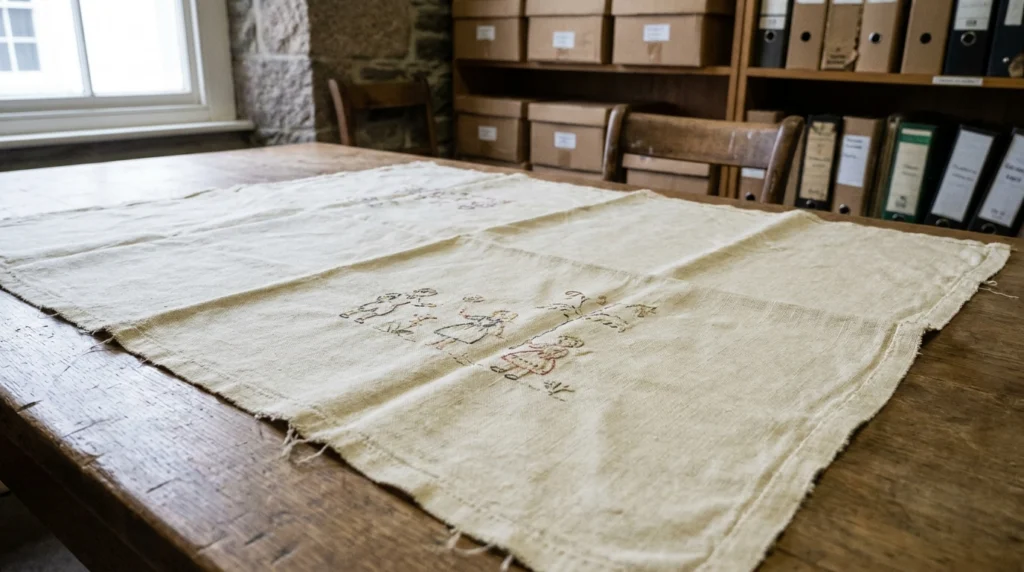
It is, on the face of it, a simple piece of fabric. Four women in crinoline dresses and bonnets, arranging flowers, rendered in careful embroidery. But the words stitched alongside the scene tell a rather different story: “Made in Jersey Prison under German Occupation, July 1943. W. N. MYLNE.” That tablecloth has now joined the Jersey Heritage collection, the BBC reports, as a quietly powerful reminder of what ordinary islanders endured under Nazi rule.
Winifred Nellie Mylne created the piece while serving a sentence handed down by the Field Command and Troop Courts. The offence, by the standards of peacetime, sounds almost absurdly minor: failing to surrender a wireless set. Under the Occupation, of course, possession of a radio was a serious matter. The Germans understood perfectly well that a population with access to BBC broadcasts was a population that had not entirely given up hope.
A Family Punished
The tablecloth tells only part of the Mylne family’s story. A document accompanying the piece reveals that Winifred’s husband, Clement Noble Mylne, a Methodist minister originally from Leytonstone in London, was sentenced alongside his wife. He too received a year’s imprisonment and a fine of 300 Reichsmarks, the official currency of Germany from 1924 until 1945. Clement was sentenced by court martial on 26 February 1943, though the BBC reports he was transferred to the General Hospital on 10 August and discharged on 22 September due to ill health.
The family’s ordeal did not stop there. The couple’s daughter, Vivienne Mylne, listed in the document as a schoolteacher and born in Zhaotong, west China, was sentenced to ten months in prison. Her offences were failing to surrender a camera and disseminating information hostile to Germany. Three members of one family, imprisoned for the possession of everyday objects and the quiet act of resistance that implied.
Everyday Objects from Extraordinary Times
Jersey Heritage’s acquisition of the tablecloth is a reminder of how material history can carry weight far beyond its physical form. A spokesperson for Jersey Heritage told the BBC: “One of the best things about our work is finding out more about everyday objects from extraordinary times.” It is hard to argue with that. The tablecloth is not a weapon, a document or a medal. It is a domestic object, made by a woman who chose to mark her imprisonment not with despair but with needlework, and to record, in thread, exactly where she was and why.
The Occupation lasted from July 1940 until Liberation in May 1945, and its legacy remains deeply woven into Jersey’s identity. Objects like this tablecloth serve as tangible connections to that period, ensuring that the experiences of individuals such as the Mylne family are not reduced to footnotes in a broader historical narrative.
Source: BBC News