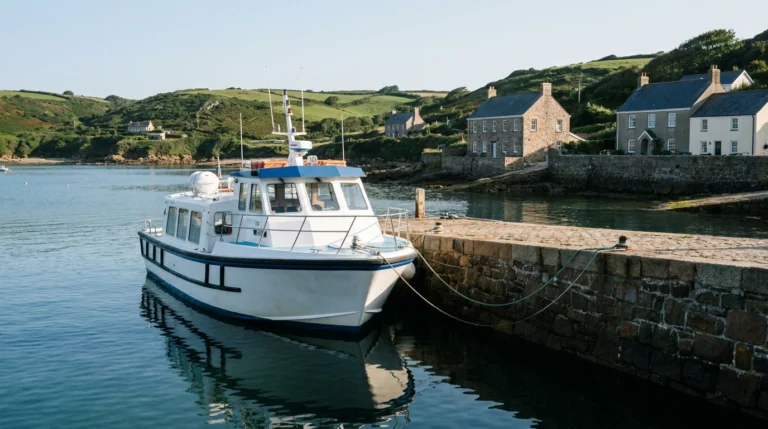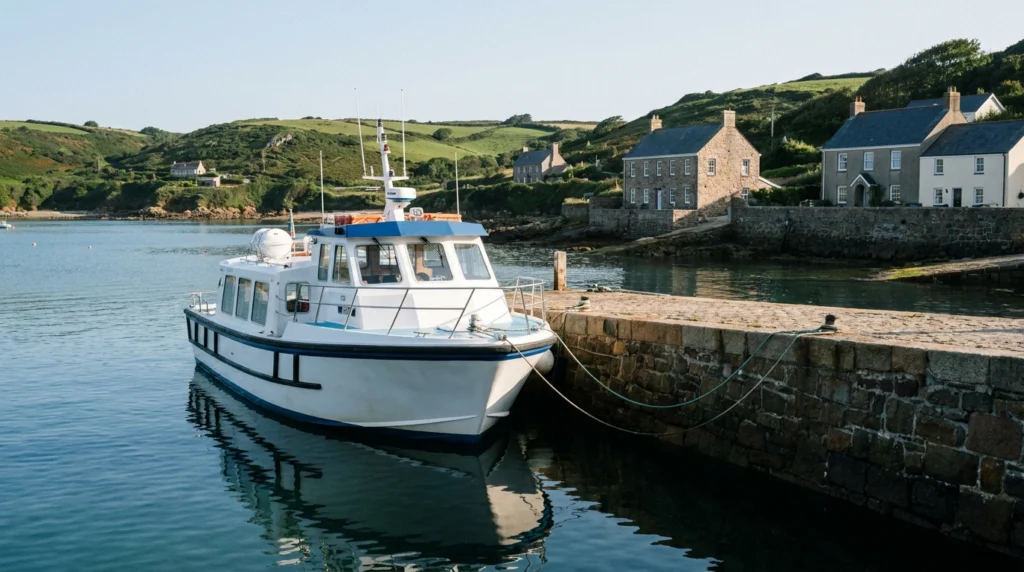
In brief: Water Taxi CI, founded by Max Boleat in 2023, is expanding its inter-island services with a new, larger vessel. The company runs bespoke routes between the Channel Islands, including a regular scheduled ferry between Jersey and Alderney, and sees Jersey as a key gateway for island-hopping tourism.
A Small Operator Making Big Waves
While the broader inter-island ferry market has had a turbulent year, one Channel Islands operator is quietly getting on with the job. Water Taxi CI, founded by Max Boleat in 2023, has been running bespoke services between the islands, including a regular scheduled route between Jersey and Alderney, and is now preparing to expand its fleet.
The company currently operates with a single vessel, but Boleat told Bailiwick Express that a new boat is on the way, and it cannot come soon enough. “We’re really, really happy with how that boat’s performed and the feedback that we get from passengers who travel on board it,” he said. “So, looking at the current market and the way things are going with inter-island travel, we’re very keen to bolster our services, hence the arrival of the new boat.”
The new vessel is described as larger, heavier and more comfortable, and Boleat says it will allow the service to operate more regularly and more reliably in adverse weather. For a small operator running routes in the Channel Islands, where the weather has a habit of making its own plans, that resilience matters enormously.
The Bigger Picture: A Market Under Pressure
Water Taxi CI’s expansion comes against a backdrop of wider concern about inter-island connectivity. Jersey’s Economic Development Minister, Gerald Voisin, told the States Assembly this week that demand for DFDS’s inter-island high-speed ferry service had been below commercially viable levels. His position was measured but clear: “I would prefer first to see market-led solutions over further government contract expansion or regulation, but I am of course prepared to consider any approach which secures sustainable inter-island connectivity.”
Boleat shares the minister’s instinct for market-led answers, but argues that a “mainstream” large ferry operator is still needed to anchor regular services across the Channel Islands. He sees Water Taxi CI not as a replacement for that, but as a complement, helping to build a genuine network that would allow tourists to move freely between islands.
“They want to be able to hop around the Channel Islands more easily, and unfortunately the islands don’t have that network between them at the moment,” he said. “We’ve kind of filled that space and we would very much like to do that more on a per person basis, but without having backings of governments at each island and making it work more collaboratively, it’s quite challenging for us to do as a small business.”
Jersey as the Gateway
Boleat is bullish about Jersey’s strategic role, describing it as being in a “unique and strong position” as an “entry and exit point” to the Channel Islands as a whole. It is a compelling argument. Jersey is the largest of the islands, the best connected to the UK and France, and the natural first port of call for most visitors. If a coherent island-hopping tourism product is ever going to exist, it almost certainly has to be built around Jersey as its hub.
For Jersey residents, the practical implications are straightforward. Better, more reliable connections to Alderney and the other islands mean more options for leisure travel, and a more attractive overall proposition for tourists who might otherwise spend their entire trip on a single island. The economic case for getting this right is not trivial.
Whether the governments of Jersey and Guernsey can find the collaborative framework that Boleat says is needed remains to be seen. Months of discussions between the two governments on improving inter-island travel have so far produced more conversation than concrete action.
Source: Bailiwick Express