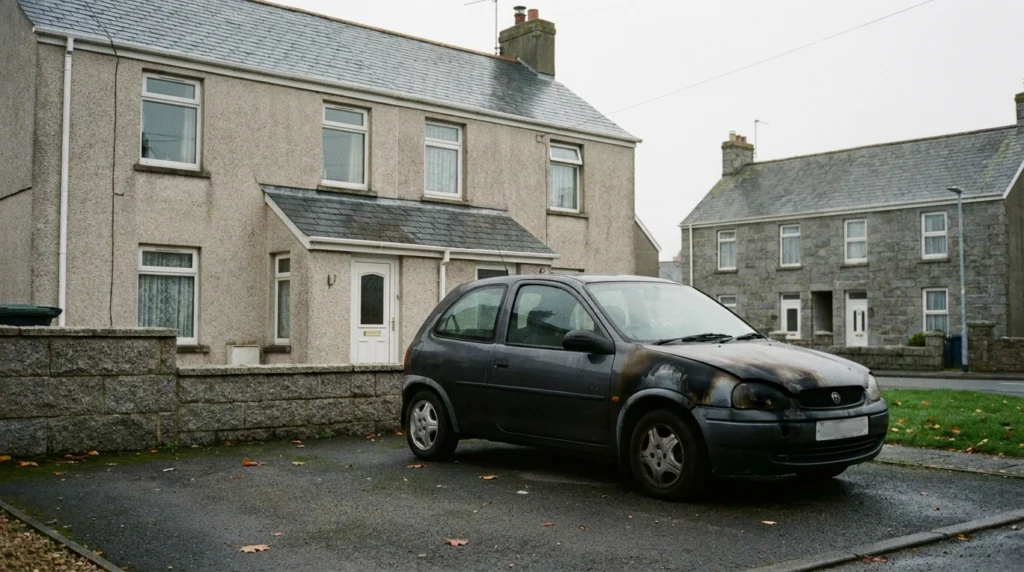
In brief: A hybrid Mini caught fire on a St Helier street, leaving its owner with nowhere safe to store the stricken vehicle overnight. The incident has exposed a significant gap in Jersey’s infrastructure for dealing with end-of-life electric and hybrid vehicle batteries, with the government acknowledging the situation is “complex” while pointing to two pilot export shipments completed this year.
Fire on the Street, Chaos at Home
When Alex Williams’s hybrid Mini began smoking on a St Helier street, things moved fast. According to the Jersey Evening Post, it took less than two minutes from the first sign of smoke to the car being fully ablaze. Firefighters arrived promptly and extinguished the blaze, but that, it turned out, was the easy part.
Mr Williams was then informed by both the police and fire service that, despite the well-documented risk of electric vehicle batteries re-igniting after a fire, there was no designated safe storage facility on the Island where the vehicle could be taken. The car was towed to his home driveway, where it sat overnight. Mr Williams, understandably unnerved by the prospect of a second fire or even an explosion, chose to spend the night elsewhere.
“I was stuck in the middle, with the police and fire service saying it was each other’s problem, and wasn’t given any alternative,” he told the JEP. It was only the following day, after contacting his insurer, that he was able to arrange for the written-off vehicle to be removed.
A Problem the Island Has Been Quietly Ignoring
Mr Williams’s ordeal has brought into sharp focus a structural problem that has been building for years. Electric and hybrid vehicles have been sold in Jersey for well over a decade, and a senior manager at one of the Island’s larger auto dealers told the JEP that older models are now reaching the point where repair is no longer economical, leaving owners looking to trade them in with nowhere for the batteries to go.
The core difficulty, the JEP reports, is that while suitable facilities exist in the UK and in Guernsey, safety regulations restrict the ability to transport fire-damaged or end-of-life EV batteries off the Island as freight. That leaves Jersey in an awkward position: enthusiastically encouraging the uptake of electric vehicles, yet without the end-of-life infrastructure to match.
As Mr Williams put it: “There’s been a definite move towards electric vehicles in terms of them being marketed as better for the environment, but it doesn’t seem like this has been matched by a solution for what happens at the end of the ‘lifecycle’ of the car.”
Government Response: Work in Progress
The Infrastructure and Environment Department issued a statement describing EV battery disposal as “a complex and highly regulated area that requires specialist handling, transport and processing arrangements.” Where batteries have been involved in a fire, the department noted, additional safety controls are required before they can be moved or exported.
The department said it is working with industry partners to establish “a fully compliant long-term solution for end-of-life electric and hybrid vehicles” and confirmed that two pilot shipments of EV batteries had been successfully completed this year. It added that public and environmental safety remains its priority.
On the specific case of Mr Williams, the department said it had had no contact with him and was therefore unable to comment on his situation directly. Anyone with an end-of-life vehicle requiring disposal was directed to contact climateemergency@gov.je.
Source: Jersey Evening Post