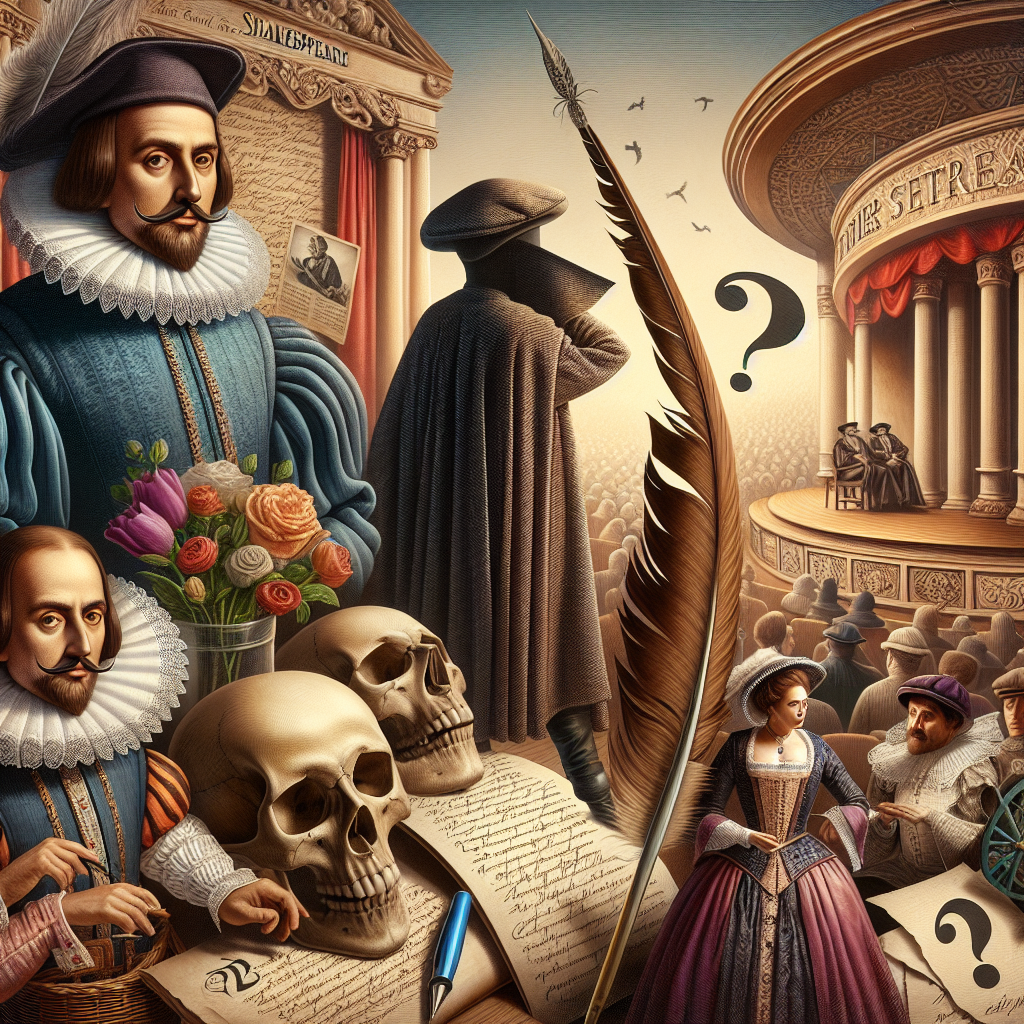
The Bard’s Quill: Who Truly Penned Shakespeare’s Works?
Summary: The debate over the true authorship of Shakespeare’s plays is a tale as old as time—or at least as old as the plays themselves. While the majority attribute the works to William Shakespeare, a persistent cloud of doubt has led some to question whether the Bard of Avon was indeed the mastermind behind these timeless pieces.
The Case for Shakespeare
William Shakespeare, the son of a glove-maker from Stratford-upon-Avon, is traditionally seen as the genius behind some of the most revered plays in the English language. His name is synonymous with literary greatness, and his works have been studied and celebrated for centuries. The Stratfordian theory, as it’s known, holds that Shakespeare’s known history as an actor and shareholder in the Lord Chamberlain’s Men, later the King’s Men, provided him with the necessary insights and opportunities to craft his plays.
The Authorship Controversy
However, the plot thickens as we delve into the authorship controversy. Skeptics, known as anti-Stratfordians, argue that Shakespeare’s limited education and modest background make it improbable that he could have written such complex texts, rich with historical and classical references. They suggest that the true author could be one of several highly educated and well-travelled individuals of the time, such as Edward de Vere, the 17th Earl of Oxford, or even playwrights like Christopher Marlowe or Francis Bacon.
Why the Doubt Persists
The doubt persists largely due to the scant evidence of Shakespeare’s life and the few surviving documents that bear his signature. Moreover, the variations in the spelling of his name on these documents have fueled speculation. The anti-Stratfordians point to the lack of direct evidence linking Shakespeare to the manuscripts as a smoking gun, suggesting that perhaps the name “Shakespeare” was a pseudonym or a front for the real author.
Jersey’s Stake in Shakespeare
While the Channel Islands may seem a world away from Elizabethan England, the Shakespeare authorship question resonates even in Jersey. The island’s own rich literary history and cultural scene mean that the works attributed to Shakespeare form a cornerstone of local education and theatre. The debate over authorship invites us to question the origins of what we consider to be culturally significant and challenges us to think critically about the narratives we accept as truth.
Examining the Evidence
Proponents of the Oxfordian theory, which posits Edward de Vere as the true author, highlight his education, courtly background, and the parallels between his life and events in the plays. Marlovians, on the other hand, suggest that Christopher Marlowe faked his death and continued to write under the guise of Shakespeare. Baconians argue that Francis Bacon’s known codes and ciphers appear within the plays, hinting at his authorship.
Yet, Stratfordians maintain that the evidence supporting Shakespeare’s authorship is robust. Records of his marriage, his children’s baptisms, and his real estate transactions all place him in the right place at the right time. Furthermore, tributes by his contemporaries, including Ben Jonson, affirm Shakespeare’s role as a playwright.
The NSFW Perspective
At NSFW, we appreciate a good mystery, especially one that has kept the world guessing for centuries. The Shakespeare authorship debate is a delightful conundrum that invites speculation and scholarly sleuthing. However, we also recognize the importance of Occam’s razor: the simplest explanation is often the correct one. While it’s tantalizing to imagine a grand conspiracy behind the name “Shakespeare,” the evidence supporting William of Stratford’s authorship is compelling.
For our conservative readership, the question of authorship may also reflect broader concerns about authenticity and the integrity of historical narratives. In an era where “woke” ideologies often seek to rewrite history, the Shakespeare authorship debate serves as a reminder to scrutinize the evidence before us and to uphold the value of tradition and established knowledge.
In conclusion, while the authorship question provides an intriguing backdrop for literary discussion, it also underscores the enduring power of Shakespeare’s works. Whether penned by a glove-maker’s son or a nobleman in disguise, the plays attributed to Shakespeare continue to captivate audiences in Jersey and beyond, proving that the magic of these works lies not in their mysterious origins, but in their timeless ability to reflect the human condition.
And so, to our readers, we say: the play’s the thing, regardless of who held the quill. Let us enjoy the rich tapestry of language and emotion woven by whoever the true Bard may be, and let the debate rage on, as it surely will, for centuries to come.



